WSPR (propagation beacons)
Very low-power beacons that each send a call sign, location and power level over two minutes, so stations can map where signals reach.
WSPR sounds like almost nothing: a faint, pure, very slow tone, often buried in the noise, that drifts in tiny steps for nearly two minutes, starting on the even minute.
What does it sound like?
A faint, very slow, steady tone that shifts pitch slightly, lasting almost two minutes.
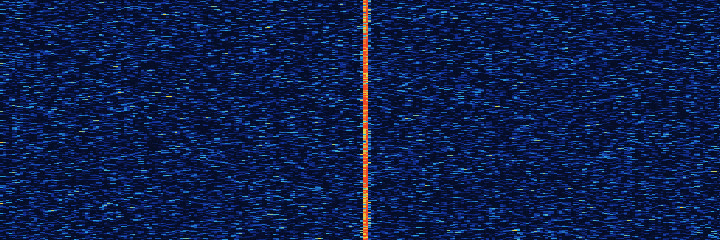
12-second example. A clean example made by our own signal generator; signals on the air usually sound noisier.
Who uses it?
Amateur radio operators studying propagation; thousands of automatic stations worldwide.
Where and when can I hear it?
A narrow slot on each ham band, for example just above 14.0956 MHz; transmissions start on even minutes.
What do the decoded parts mean?
- Call sign: The beacon station.
- Grid square: Its location.
- Power: Transmitter power in dBm (for example 23 dBm is 0.2 watts).
Easily confused with
- FST4 / FST4W: FST4W is its slower relative
- FT8: FT8 is wider and turns every 15 s
How to recognize it
WSPR (pronounced "whisper") changes among four tones spaced only about 1.5 Hz apart, at about 1.5 steps per second. To the ear, that is a single thin whistle with a slight wobble, if you can hear it at all. Each transmission lasts about 110.6 seconds and starts one second after an even minute (00, 02, 04...).
On a waterfall, WSPR looks like a set of very narrow, faint, slightly wavy lines inside a 200 Hz window. Dozens of stations can share that window because each signal is only about 6 Hz wide.
Easily confused with:
- FT8: much busier, with 15-second turns and signals 50 Hz wide.
- An unmodulated carrier or birdie: a steady tone that never stops on the two-minute cycle.
- Morse beacons: switched on and off, not continuous.
Where and when to hear it
WSPR has a slot on nearly every ham band. Common dial frequencies (upper sideband) include 3.5686, 7.0386, 10.1387, 14.0956, 18.1046, 21.0946, 24.9246 and 28.1246 MHz, with the signals 1400-1600 Hz above the dial. The 20- and 30-meter bands are almost always busy.
You rarely hear WSPR by ear. The point is automatic reporting: receiving stations upload what they decode to the WSPRnet database, which logs millions of reports and shows, minute by minute, which paths are open. Small high-altitude balloons circling the globe often carry WSPR transmitters for tracking.
If you want to hear WSPR by ear, pick 30 or 20 meters, tune to the dial frequency in upper sideband and listen near 1500 Hz in the audio just after an even minute. On a strong night you may catch a faint, steady whistle; more often, only a waterfall display reveals the thin wavering lines.
A little history
Joe Taylor, K1JT, released WSPR in 2008 as a tool for studying how radio waves travel. Its design trades speed for sensitivity: one short message of call sign, four-character grid square and power level takes almost two minutes to send, but it can be decoded at signal levels around 28 dB below the noise in a normal receiver bandwidth.
Because stations often send with less than one watt, WSPR has shown how far tiny signals can travel, and its archive has become a large public dataset for studying the ionosphere.
Common questions
Is it legal to listen to WSPR?
Yes. WSPR beacons are open amateur transmissions, and the database of reports is public.
Why can't I hear WSPR signals?
Most are far below the level your ear can detect. WSPR is designed to be decoded by software well under the noise.
What does the power number in a WSPR report mean?
It is the transmitter power in dBm: 30 dBm is 1 watt, 23 dBm is 0.2 watts, and 37 dBm is 5 watts.
How do I receive WSPR?
The free program WSJT-X includes a WSPR mode. Tune to a WSPR dial frequency in upper sideband with an accurate computer clock, and optionally upload your reports to WSPRnet.