STANAG 4285 (NATO modem)
A NATO standard for sending data over shortwave with a single wide tone.
What does it sound like?
A steady, rough hiss about 3 kHz wide, like a waterfall of static.
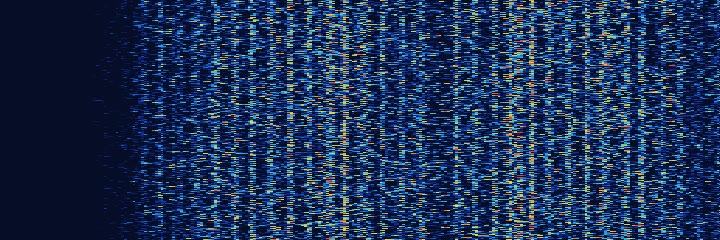
12-second example. Made by Cohera's own STANAG 4285 generator (the 1,200 bits-per-second setting, carrying random test data), with simulated static crashes and a small tuning offset added.
Who uses it?
Military and naval stations.
Where and when can I hear it?
Various HF frequencies, often continuous for long periods.
The science
STANAG 4285 is a single-tone modem: one 1800 Hz audio subcarrier is phase-shift keyed at a constant 2400 symbols per second, using 8-PSK (eight phases) for the fastest mode and QPSK or BPSK for slower, sturdier ones. Every frame of 256 symbols begins with an 80-symbol, 33.33-millisecond known preamble and then alternates four 32-symbol data segments with three 16-symbol known probe segments, which the receiver's equalizer uses to track echoes and fading. With error-correcting codes from rate 1/16 to 2/3 and a short or long interleaver, user rates run from 75 to 2400 bits per second; uncoded modes run at 1200, 2400 and 3600 bits per second.
Why use it?
The same waveform can trade speed for robustness: up to 3600 bits per second when the path is good, down to 75 bits per second when it is poor. The waveform has no automatic rate signaling, so both ends must be set to the same rate and interleaver. The long interleaver spreads data across time so a fade or noise burst damages only scattered bits that the error correction can repair.
Lore
NATO released the first edition of STANAG 4285, a NATO standardization agreement, in February 1989 under a title naming 1200, 2400 and 3600 bit-per-second single-tone modems for HF radio links. Makers still support it for compatibility with the NATO Broadcast and Ship-to-Shore (BRASS) systems used by navies.