SCAMP
A family of simple keyboard modes designed for weak-signal chatting.
What does it sound like?
A plain two-tone or on-off keying pattern, slower than RTTY.
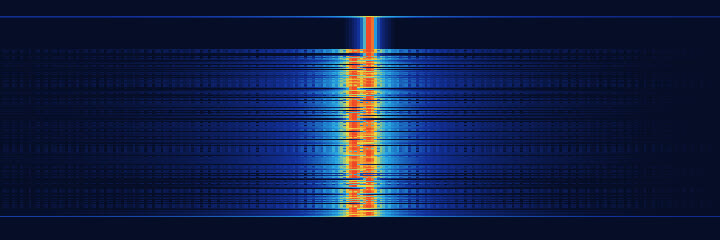
12-second example. A clean example made with the free fldigi program (SCAMP FSK); signals on the air usually sound noisier.
Who uses it?
Amateur radio experimenters.
Where and when can I hear it?
Various ham frequencies; rarely heard.
The science
SCAMP (Simple Conversational Amateur Messaging Protocol) uses simple modulation, either on-off keying like Morse code or two-tone frequency-shift keying like RTTY, but adds strong error correction. Text is packed two 6-bit characters at a time into a 24-bit extended Golay code word, which can correct up to 3 flipped bits, and each 30-bit frame includes extra transitions to help the receiver keep time. Speeds range from about 7 to 83 bits per second, roughly 5.6 to 67 words per minute, with the slower modes reaching lower signal-to-noise levels.
Why use it?
SCAMP was designed so that a simple, home-built radio with an 8-bit microcontroller like an Arduino can send and decode it without a computer, while still using the low symbol rate and forward error correction of modern weak-signal modes. Unlike FT8, which is built around exchanges such as signal reports and a global clock, it must carry arbitrary messages that an emergency might need, without global clock synchronization.
Lore
Electrical engineer Daniel Marks designed SCAMP together with the RFBitBanger, a small HF radio kit meant to be buildable from common parts, a goal he tied to recent supply-chain shortages. He released the code under the permissive zlib license to encourage adoption.
Easily confused with
- Radioteletype (RTTY), from the same family
- NAVTEX (maritime safety text), from the same family