Weather satellite pictures (APT)
The analog picture signal that NOAA's older weather satellites sent as they passed overhead. The last one went quiet in August 2025.
What does it sound like?
A distinctive 'tick-tock' sound, two ticks per second (APT ended in 2025).
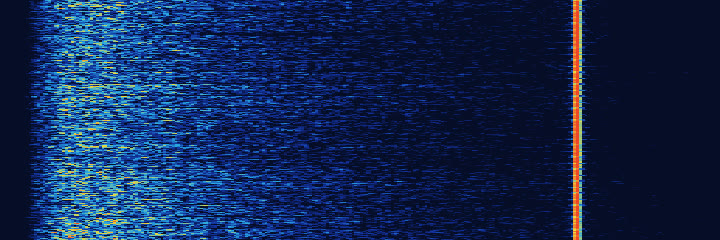
10.0-second example. Recording: NOAA-19 recording by saphe, Freesound 189860 (CC BY 4.0).
Who uses it?
NOAA-15, NOAA-18 and NOAA-19, all now decommissioned (NOAA-18 on June 6, NOAA-19 on August 13 and NOAA-15 on August 19, 2025). Russia's Meteor-M satellites still send pictures near 137 MHz, in a digital format (LRPT).
Where and when can I hear it?
137.1-137.9 MHz. Today you'll hear Meteor-M's digital picture signal there rather than APT; old APT recordings are still widely shared.
The science
APT sent pictures one line at a time, two lines per second. The brightness of each point set the strength of a 2400 Hz audio tone (amplitude modulation), and that tone was then placed on a carrier near 137.5 MHz with FM, so an ordinary FM receiver produced audible picture data. Each line of each image channel began with a short sync burst, seven cycles of a 1040 Hz square wave for one channel and seven pulses at 832 pulses per second for the other, and those bursts make the tick-tock you hear. The two channels showed the same scene in different wavelengths, typically visible light by day and infrared, at about 4 kilometers per pixel.
Why use it?
APT was designed so that anyone with simple, inexpensive equipment could receive live cloud pictures while a satellite was in range, with no ground network in between. NOAA switched off its last APT-carrying polar satellites in 2025: NOAA-18 on June 6, NOAA-19 on August 13 and NOAA-15 on August 19. The series, which ran for 47 years, also relayed distress beacons for the international search-and-rescue system, which NOAA credits with helping save more than 24,400 lives since 1982.
Lore
NASA's TIROS 8, launched December 21, 1963, was the first satellite with Automatic Picture Transmission; more than 50 ground stations took part before its APT camera degraded and the experiment ended by the end of April 1964. With no propulsion, NOAA's retired polar satellites are expected to stay in orbit for about 150 years.
What do the decoded parts mean?
- Image: A strip picture of the ground and clouds below the satellite, in visible and infrared light.
Easily confused with
- Satellite telemetry beacon, from the same family