Radar pulses and sounders
Pulsed radars and 'sounders': equipment that sweeps across frequencies to measure the ionosphere, or measures ocean currents.
Radar pulses and sounders sound like a quick 'zip' or swoosh as a sweep passes through your receiver, or a steady rapid ticking or buzzing that stays on one frequency.
What does it sound like?
A quick 'zip' or chirp as a sweep passes by, or regular clicks and pulses.
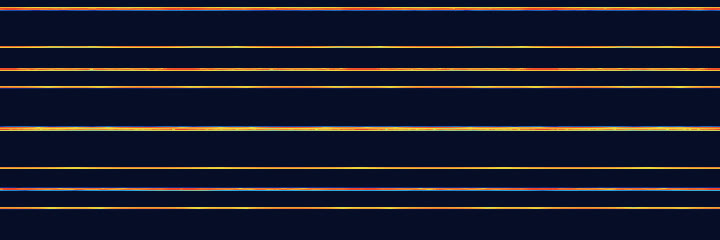
12.0-second example. A microwave search radar's pulses, picked up by a Japanese navy (JMSDF) patrol aircraft's radar detector and converted to sound by Japan's Ministry of Defense, which released it in January 2019 (Wikimedia Commons, CC BY 4.0). It is not an HF sounder or over-the-horizon radar, and an ordinary radio can't tune it.
Who uses it?
Research agencies, weather and ocean monitoring, and defense organizations.
Where and when can I hear it?
Across shortwave (ionosondes sweep the whole range) and on VHF/UHF. Ship and aircraft search radars use microwave frequencies that ordinary radios don't tune.
Hear it live
- University of Twente WebSDR (Enschede, the Netherlands)
This page shows ionograms made by this receiver from chirp sounders sweeping the shortwave range. Not every sounder is on all the time.
These are free public receivers run by other people; we only link to them. You'll hear the signal only if it's on the air right now and conditions carry it to that receiver, so if it's quiet, try another time. Links last reviewed 2026-09-28.
The science
An ionosonde is a radar pointed straight up. It steps its transmitter through the shortwave range, typically from about 1 MHz up to 20 MHz or higher (some sweep to 40 MHz), and times the echoes returning from ionized layers that peak roughly 70 to 400 kilometers overhead. Each frequency either reflects or passes through, so the result, called an ionogram, is a graph of apparent reflection height against frequency. Coastal ocean radars work differently: they send HF signals across the sea surface and listen for echoes from waves exactly half the radio wavelength long (at 25 MHz, a 12-meter radio wave picks out 6-meter ocean waves), then work out the surface current from how much the echo's frequency is shifted beyond what the waves alone would cause.
Why use it?
Ionograms show which frequencies the ionosphere will carry at the moment and help scientists track space-weather disturbances. The U.S. network of about 180 coastal HF radars maps surface currents in near real time, in any weather, out to about 200 kilometers. The Coast Guard began using the data for search and rescue in 2009, and during the 2010 Deepwater Horizon spill NOAA used it to produce daily oil trajectory maps.
Lore
In 1925 Gregory Breit and Merle Tuve published a radio method for measuring the height of the ionosphere by timing pulsed echoes; they watched the reflecting layer rise from about 60 to more than 115 miles after sunset. A National Academy of Sciences memoir notes that confirming the ionosphere this way also suggested radar was practical.
Easily confused with
- Over-the-horizon radar, from the same family
How to recognize it
These signals do not carry messages; they measure things. Their sound depends on how they work:
- Chirp sounders sweep smoothly across the whole shortwave range. Your receiver only hears a slice a few kilohertz wide, so the sweep flashes past as a short rising or falling "zip," then silence until the next sweep minutes later.
- Ionosondes step through frequencies sending short pulses, heard as a brief burst of ticks or a rough buzz as they pass.
- Ocean current radars near coasts repeat a sweep about once or twice a second, giving a regular "whoosh... whoosh".
- Over-the-horizon radars send powerful pulses or sweeps many times a second, heard as a loud, wide knocking, tapping or buzz that can blanket part of a band.
Easily confused with: electrical interference, which is usually steadier and tied to the power line's 60 or 120 Hz buzz (50 or 100 Hz outside North America), and data modes, which have a message-like rhythm rather than a pure repeating pattern.
Where and when to hear it
Anywhere on shortwave. Ocean radars have their own allocations, set by the 2012 World Radiocommunication Conference, including 4.438-4.488, 5.250-5.275, 13.450-13.550 and 24.450-24.600 MHz, and you can hear them strongly near coastlines. Over-the-horizon radars often intrude into the ham bands; the IARU Intruder Watch Service publishes monthly newsletters of the ones it logs.
Chirp and ionosonde sounders run day and night from research sites and military stations worldwide, so patient listening on any quiet frequency will eventually catch one passing through.
A little history
Ionosondes have measured the ionosphere, the electrically charged upper atmosphere that bends shortwave signals back to Earth, since the 1920s and 1930s; their readings tell forecasters which frequencies will work. The most famous radar sound in radio history is the "Russian Woodpecker," a Soviet over-the-horizon radar (Duga) whose loud 10-pulse-per-second tapping disrupted shortwave listening from 1976 to 1989. Modern systems such as Australia's Jindalee Operational Radar Network keep the technique alive.
Coastal ocean radars became widespread from the 1990s and now map surface currents for search and rescue, oil spill response and forecasting along many coastlines.
Common questions
Is it legal to listen to radar and sounder signals?
Yes. They carry no messages, and hearing them is ordinary radio listening. Many hobbyists log them as part of monitoring propagation.
What was the Russian Woodpecker?
A Soviet over-the-horizon radar, known as Duga, whose repetitive tapping at about 10 pulses per second was heard worldwide on shortwave from 1976 until 1989. Its huge antenna still stands near Chernobyl in Ukraine.
Why do I hear a 'zip' every few minutes on a quiet frequency?
Most likely a chirp sounder sweeping across the shortwave spectrum. It passes through your receiver's narrow listening window in a fraction of a second.
Can I decode a chirp sounder?
There is no message to decode, but with a GPS-locked software-defined radio, open-source tools such as the chirpsounder2 project can detect sounders and turn them into pictures of the ionosphere.
Sources
- IARU Intruder Watch Service (IWS) newsletters
- 47 CFR 2.106, US Table of Frequency Allocations (oceanographic radar footnotes such as 5.145A and 5.158)
- CODAR Ocean Sensors: HF radar technology
- chirpsounder2 (Juha Vierinen)
- Australian Department of Defence: JORN Mid Life Upgrade
- NOAA NGDC: Digisonde Portable Sounder manual, Introduction to ionospheric sounding
- National Academy of Sciences memoir: Merle Antony Tuve
- CODAR Ocean Sensors: The unique nature of HF radar
- NOAA IOOS: HF Radar
- University of Twente WebSDR: chirp receiver (ionograms)