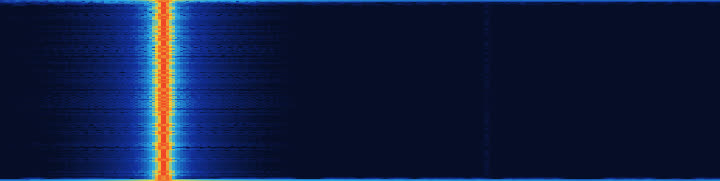
0 Hz1,0002,0003,000 Hz
Tap a step to hear that moment. The box shows where it is on the waterfall.
A slow, very narrow text mode designed for live keyboard conversations between hams.
PSK31 sounds like a soft, steady warble on a single pitch, a gentle 'wobbling' tone, often with several of them side by side a few dozen hertz apart.
A soft, steady warbling tone, often several side by side.
4.5-second example. A clean example made by our own signal generator; signals on the air usually sound noisier.
This computer-made PSK31 test clip is a single steady tone whose wave flips over about 50 times in 4.5 seconds, always on a 32-millisecond beat.
Tap a step to hear that moment. The box shows where it is on the waterfall.
Make your own: type a message and hear it as PSK31 in the Signal Maker.
Amateur radio operators.
Around 14.070 MHz and similar spots on other ham bands.
Hear it live
These are free public receivers run by other people; we only link to them. You'll hear the signal only if it's on the air right now and conditions carry it to that receiver, so if it's quiet, try another time. Links last reviewed 2026-09-28.
PSK31 sends a single audio tone and encodes data in its phase: a reversal of the wave (a 180-degree flip) means zero, and no reversal means one, at 31.25 symbols per second, which works out to about 50 words per minute. The tone's amplitude is smoothly shaped so it dips to zero at each reversal, which keeps the signal only about 60 Hz wide. Letters use Varicode, a variable-length code in which common characters get the shortest patterns (the space is a single bit and lowercase e is two), and two zeros in a row always mark the gap between characters. The standard BPSK version has no error correction; a QPSK variant adds convolutional coding.
Its narrow bandwidth lets many conversations share the space of one voice channel, reduces its susceptibility to noise, and allows effective communication at low power. The speed was chosen to match comfortable typing, which suits live keyboard chat.
English amateur Peter Martinez, G3PLX, described PSK31 in the RSGB journal RadCom in December 1998 and January 1999. He wrote that about 50 words per minute needs roughly 32 bits per second, and chose 31.25 because it is easily derived from the 8 kHz sample rate used in many DSP systems. W1AW, the ARRL's station, still sends bulletins in PSK31 on its rotating schedule.
PSK31 uses a single tone and sends data by flipping its phase 31.25 times per second. Each flip briefly dips the volume, so the ear hears a smooth, fluttering warble rather than separate notes. When a station is idle between words, it sends continuous phase flips, which on a waterfall look like two thin parallel lines, sometimes called railroad tracks.
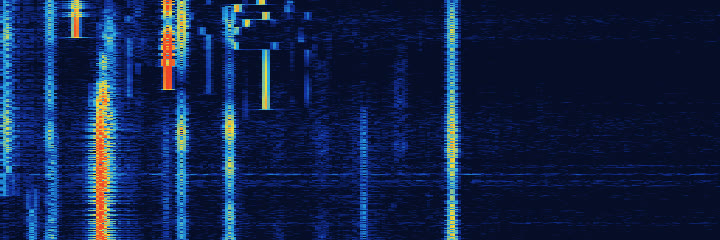
The signal is tiny, only about 60 Hz wide, so a 3 kHz slice of band can hold dozens of conversations. Clean signals look like neat narrow stripes; an overdriven transmitter shows extra stripes on either side.
Easily confused with:
The best-known spot is 14.070 MHz (upper sideband) on 20 meters, with activity in the first couple of kilohertz above it. Other common spots include 3.580, 7.070 (in the Americas), 10.142, 18.100, 21.070 and 28.120 MHz. Activity has fallen since FT8 arrived, so weekends and evenings are the best times.
For a signal with known text, W1AW sends ARRL bulletins in PSK31 on a rotating schedule, on frequencies including 7.095 and 14.095 MHz.
A typical PSK31 contact is relaxed and chatty: a CQ call, then an exchange of names, locations, equipment and weather, typed live at roughly the speed people type. Because signals are so narrow, it rewards careful tuning; a signal a few hertz off center decodes poorly or not at all.
Peter Martinez, G3PLX, developed PSK31 in the late 1990s, building on earlier phase-shift experiments by Polish amateur Pawel Jalocha, SP9VRC. Martinez designed it for live, typed conversation at about typing speed, and it soon ran on the sound cards that had become common in home computers.
A clever part of the design is its alphabet, called Varicode: common letters get short codes and rare ones long codes, much like Morse code. Lowercase letters are the most common, so they are sent faster than capitals. PSK31 quickly became the most popular keyboard mode on HF, and it stayed busy until FT8 drew much of the digital activity away.
Yes. PSK31 is an open amateur mode, and anyone may receive it.
It does not switch between tones. It keeps one tone and flips its phase, and each flip briefly softens the sound, producing a regular flutter at the 31.25-per-second rate.
Its Varicode alphabet gives the shortest codes to the most frequent characters, and lowercase letters appear far more often than capitals in normal text.
Free programs such as fldigi decode PSK31. Tune in upper sideband and click on a signal in the waterfall; many programs can decode several signals at once.