Pager signal (POCSAG)
The most common protocol for sending messages to pagers, at 512, 1200 or 2400 bits per second.
A pager signal (POCSAG) sounds like a loud, harsh buzzing burst, a rough 'brrrrt' of data that can last from a fraction of a second to several seconds.
What does it sound like?
A harsh, buzzing 'brrrrt' burst, like a fast fax or modem.
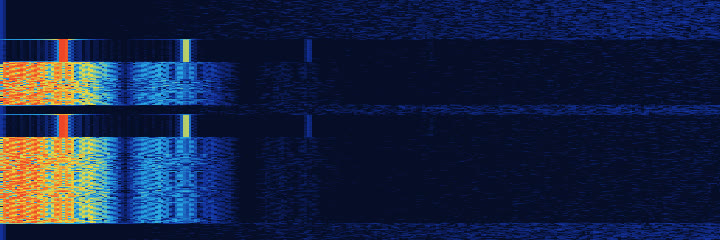
12-second example. A clean example made by our own signal generator; signals on the air usually sound noisier.
Who uses it?
Hospitals, fire departments and businesses, commercial paging services, and hams (for example the DAPNET amateur paging network).
Where and when can I hear it?
VHF and UHF paging channels, and ham frequencies such as 439.9875 MHz for DAPNET.
Easily confused with
- Radioteletype (RTTY): RTTY runs continuously
- APRS (position and messaging): APRS uses 1,200/2,200 Hz audio tones
How to recognize it
POCSAG switches the transmitter's frequency between two values (frequency-shift keying) at 512, 1200 or 2400 bits per second. Heard through an FM receiver, that becomes a coarse, raspy buzz. Faster speeds sound higher and smoother; 512 bits per second has a slower, grittier texture.
Each transmission starts with a long preamble of alternating bits, heard as a steady, even buzz, followed by the data in fixed-size batches. Paging transmitters are often powerful and cover a whole city, so the bursts tend to be strong and frequent on a busy channel.
Easily confused with:
- FLEX paging: a newer paging protocol with a similar harsh sound, sent in a strict timed rhythm of frames.
- APRS and packet radio: shorter, softer two-tone modem bursts on ham frequencies.
- Digital voice (DMR, P25): a continuous buzz for the length of someone speaking, not short data bursts.
Where and when to hear it
Paging networks use VHF and UHF channels assigned to paging services; in North America, many sit in the 150-160 MHz range and around 929-932 MHz. Hospitals and emergency services still rely on pagers because the signals reach inside large buildings and batteries last for weeks.
Radio amateurs run their own open paging network, DAPNET, which uses POCSAG on 439.9875 MHz in many countries. Its messages, such as weather alerts, news and personal ham messages, are sent for the amateur community, which makes it the natural place to learn how paging works.
A little history
POCSAG is named after the Post Office Code Standardisation Advisory Group, formed by the British Post Office in the 1970s to agree on a common paging code. It was adopted internationally as a standard radiopaging code in the early 1980s and became the most widely used paging format in the world. Motorola's FLEX protocol followed in the 1990s, offering higher speeds and better battery life.
Paging peaked in the 1990s, before mobile phones took over personal messaging, but the technology never disappeared. Its simplicity, wide coverage and reliability keep it in service in healthcare, fire services and industry.
Common questions
Is it legal to listen to pager signals?
It depends on where you live and what you do with what you receive. Hearing the signal itself, or identifying that it is POCSAG, is ordinary radio listening. However, some countries, including the United States and the United Kingdom, have laws about receiving, using or passing on the content of messages carried by services like paging, even though the signal is not encrypted. Check the rules where you are before doing anything with message content.
Why do pager signals sound so loud and harsh?
Paging transmitters use strong frequency-shift keying and high power so that pagers deep inside buildings still receive them. Through an ordinary FM receiver, that fast, wide switching comes out as a coarse buzz.
Are pagers still used?
Yes. Many hospitals, fire departments and industrial sites still use them, and radio amateurs run the DAPNET paging network.
Can I learn how POCSAG works hands-on?
The simplest lawful starting point is the amateur DAPNET network, whose messages are meant for the ham community. Open-source demodulators exist that can recognize the POCSAG format from a receiver's audio.