PACTOR
A shortwave data mode that sends email and files, with the receiving station acknowledging each block.
What does it sound like?
Short chirping bursts that alternate between two stations, back and forth.
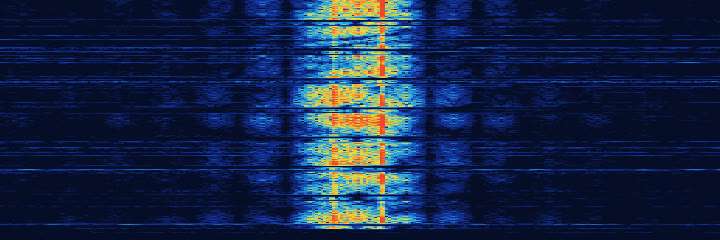
10.4-second example. PACTOR-I made with the open-source hfmodem program, then given simulated shortwave fading, a small tuning offset and static crashes; signals on the air are often weaker than this.
Who uses it?
Ships (for example SailMail), Winlink email users and emergency groups.
Where and when can I hear it?
Various HF channels, including Winlink and SailMail station frequencies.
The science
The original PACTOR uses two-tone FSK with a recommended 200 Hz shift at either 100 or 200 baud, working in a fixed 1.25-second cycle: 0.96 seconds of data packet, 0.12 seconds for the receiving station's short acknowledgment, and 0.17 seconds of idle time. That acknowledgment is automatic repeat request (ARQ): every packet carries a CRC check, and a packet that fails it is sent again. With memory ARQ, offered by some implementations, the receiver stores the relative strength of each bit from failed copies and combines them with later repeats, and Huffman compression cuts English text to an average of 4 to 5 bits per character. The fourth generation, PACTOR-4, fits in a 2400 Hz bandwidth and reaches up to 10,500 bits per second net, about twice PACTOR-3.
Why use it?
PACTOR moves checked data over fading shortwave paths, which is why it is used at sea and in remote regions without internet or satellite links. The link adapts its speed to conditions automatically, and PACTOR-4 runs on any standard SSB transceiver.
Lore
Hans-Peter Helfert and Ulrich Strate described PACTOR, with memory ARQ and data compression, in QEX magazine in October 1991. SCS of Hanau, Germany, the company behind PACTOR, developed it through four generations.
Easily confused with
- STANAG 4285 (NATO modem): STANAG runs continuously
- ALE (automatic link establishment): ALE bursts are rapid and repeated across channels