Olivia
A very robust text mode that spreads each character across many tones, so it copies through noise and fading.
What does it sound like?
A choir of tones hopping up and down, like a slow, busy music box.
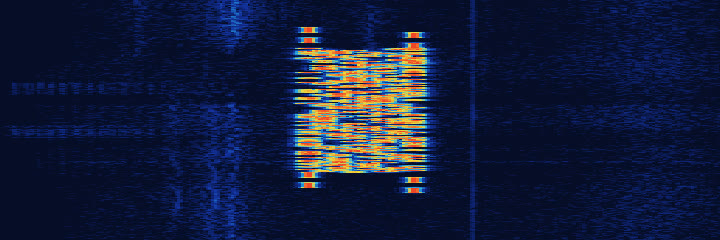
12-second example. A clean example made with the free fldigi program; signals on the air usually sound noisier.
Who uses it?
Amateur radio operators, including nets and emergency groups.
Where and when can I hear it?
Various ham frequencies; common formats use 8 to 32 tones across 250 to 1000 Hz.
The science
Olivia is multiple frequency-shift keying (MFSK): it sends one tone at a time, chosen from a set, with the tones spaced exactly as far apart as the symbol rate, for example 31.25 Hz in the common formats. Formats are named tones/bandwidth, such as 32/1000 (32 tones across 1000 Hz, the default calling format) or 8/250. Error correction is built in full-time: each 7-bit character is encoded as one of 64 Walsh functions, then scrambled and interleaved across tones and time, so even when noise wipes out some symbols the character can still be recovered. The price is speed: fldigi lists its standard formats at about 15 to 58 words per minute, with the common 8/250 and 32/1000 formats near 15 and 24.
Why use it?
Olivia's heavy redundancy lets it copy signals well below the noise, as low as about -14 dB signal-to-noise in fldigi's figures, and it tolerates fading and multipath that ruin simpler modes. That suits it to difficult paths and low power, where reliable copy matters more than speed.
Lore
Olivia was designed by Polish amateur Pawel Jalocha, SP9VRC, who published its specification; he also wrote MT63. Because the signals can be too weak to see, Olivia users rely on patience: tips reprinted in fldigi's manual advise waiting 45 to 60 seconds between calls, since the far station's decoder may take 4 to 20 seconds or more to catch up.
Easily confused with
- Contestia: Contestia is Olivia's faster cousin
- MFSK (MFSK16/32): MFSK16 has 16 tones and sends text faster