Narrow FM voice
Voice sent with frequency modulation in a narrow channel, the standard for local two-way radio.
What does it sound like?
Clear, quiet speech that cuts in and out as people press and release the talk button, often with a short burst of noise at the end.
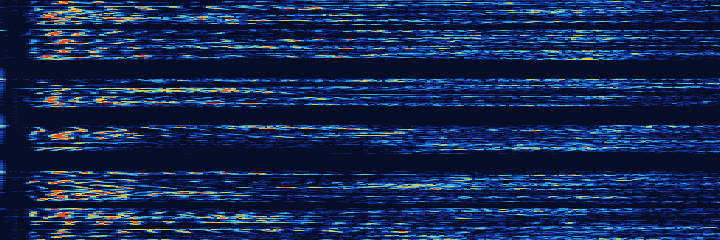
12.0-second example. Recorded off the air on the developer's own receiver (NOAA Weather Radio, a US government broadcast).
Who uses it?
Ham repeaters, businesses, public safety agencies, GMRS and FRS family radios, and NOAA Weather Radio.
Where and when can I hear it?
VHF and UHF: for example 144-148 and 420-450 MHz for hams, 462-467 MHz for GMRS/FRS, and 162.400-162.550 MHz for NOAA Weather Radio in the US.
The science
Frequency modulation keeps the signal's strength constant and instead nudges its frequency up and down in step with the voice. Since January 2013, public safety and business radio systems in the 150-512 MHz range must use technology with 12.5 kHz efficiency, and a ham VHF FM voice signal occupies roughly 10 to 15 kHz. Receivers use squelch, a circuit that silences the speaker until a signal arrives, which is why these channels sound quiet between transmissions. NOAA Weather Radio, also FM, sends a 1050 Hz alert tone that sets off the alarm on receivers with a tone-alert feature.
Why use it?
Because the sound rides on frequency rather than strength, most static and electrical noise, which mainly changes a signal's strength, is largely rejected, so strong local FM sounds clean. The radios are simple, and squelch makes it practical to leave a channel on all day. That combination made FM the usual choice for repeaters, businesses and public agencies.
Lore
On January 1, 2013, the FCC required public safety and business radio systems between 150 and 512 MHz to stop using 25 kHz efficiency technology and move to at least 12.5 kHz efficiency, the end of an effort begun almost two decades earlier that it calls narrowbanding. The goal was to fit more channels into the same spectrum.
Easily confused with
- AM voice, from the same family
- Single-sideband voice (SSB), from the same family
- FM broadcast, from the same family