MT63
A very robust text mode spreading data across 64 tones, designed to survive noise and interference.
What does it sound like?
A dense, steady rushing sound, like wind with a musical texture.
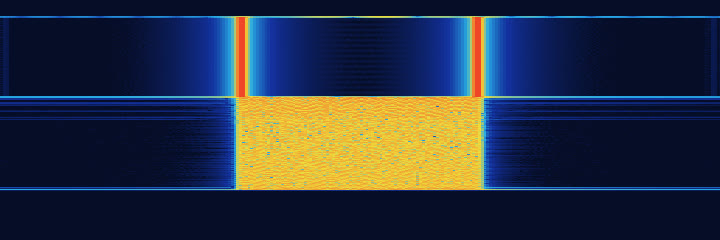
12-second example. A clean example made with the free fldigi program; signals on the air usually sound noisier.
Who uses it?
Amateur radio operators, especially emergency-communications groups.
Where and when can I hear it?
Various ham frequencies on HF and VHF.
The science
MT63 transmits 64 tones at once, a technique called orthogonal frequency-division multiplexing, and each tone carries data by phase reversals (differential BPSK). Every 7-bit character is encoded as a 64-point Walsh function and interleaved over many symbols, 3.2 or 6.4 seconds in the standard MT63-1000 format, so a burst of noise or a fade damages only a small part of each character. The three standard formats are 500, 1000 and 2000 Hz wide at 5, 10 and 20 characters per second.
Why use it?
Spreading each character over time and frequency makes MT63 resistant to interference: fldigi shows an MT63-500 signal decoding with several PSK31 signals sitting on top of it. It is also forgiving of tuning, around 100 Hz of error, and at 5 to 20 characters per second it is quick enough for passing typed messages.
Lore
MT63 was designed by Polish amateur Pawel Jalocha, SP9VRC, who also created Olivia. The long interleaver has a cost: in MT63-1000 with the long setting, the receiving text lags the signal by 12.8 seconds.
Easily confused with
- STANAG 4285 (NATO modem): STANAG 4285 is a single, wider carrier
- Digital Radio Mondiale (DRM): DRM is about 10 kHz wide on broadcast bands