MSK144 (meteor scatter)
A mode for bouncing signals off the trails of meteors, using very short bursts that ride brief reflections.
What does it sound like?
Mostly silence with sudden short 'pings' when a meteor trail reflects the signal.
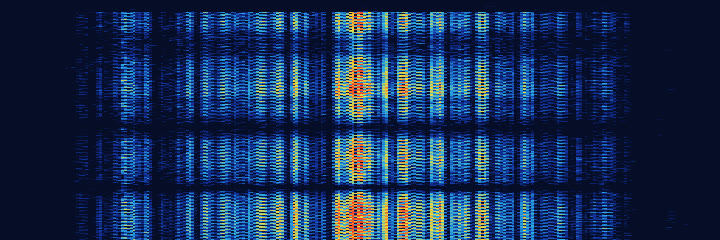
12.0-second example. Two short meteor "pings" of MSK144 on 6 meters, in the receiver's hiss, recorded off the air during the August 2025 Perseid meteor shower; WSJT-X's decoder reads both. Recording: Tim Goeppinger N6GP / HamSCI Meteor Scatter QSO Party, Zenodo 17875540 (CC BY 4.0).
Who uses it?
Amateur radio operators on VHF.
Where and when can I hear it?
For example 50.260 or 50.280 MHz (6 meters) and 144.150 MHz (2 meters).
The science
MSK144 packs a 77-bit message and a 13-bit checksum into a 128-bit LDPC error-correcting codeword, then adds two 8-bit sync patterns to make a 144-bit frame. It sends 2000 bits per second using offset quadrature phase-shift keying shaped so the signal behaves like minimum-shift keying (MSK), a smooth, constant-power waveform; one frame takes 72 milliseconds, an effective rate of up to 250 characters per second. Frames repeat without gaps through each transmission, usually 15 seconds, so any brief meteor reflection is likely to catch at least one whole frame, and a 20-millisecond short form can be read from even briefer pings.
Why use it?
Meteor trails reflect VHF signals for only a moment, so the mode has to deliver a complete message in a fraction of a second; MSK144's speed and coherent decoding let it use pings shorter than a tenth of a second. That makes VHF contacts out to about 1300 miles possible on any day of the year, independent of weather, solar activity or band openings.
Lore
Meteor-scatter communication was first described in QST in 1953. MSK144, by Steve Franke (K9AN) and Joe Taylor (K1JT), was introduced in summer 2016 and quickly became the worldwide mode of choice for meteor scatter, following FSK441, the first amateur digital mode designed for meteor pings, which K1JT introduced with his WSJT program in 2001.
Easily confused with
- FT8: FT8 is continuous for 13 seconds, not short pings