MFSK (MFSK16/32)
A text mode using many tones, able to send text and small images.
What does it sound like?
A rapid, bubbling series of pure tones.
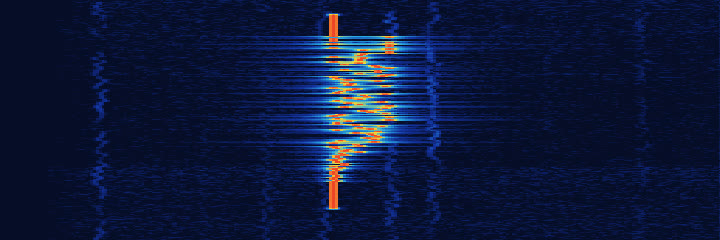
12-second example. A clean example made with the free fldigi program; signals on the air usually sound noisier.
Who uses it?
Amateur radio operators, and the Shortwave Radiogram broadcasts, which send text and pictures.
Where and when can I hear it?
Various ham and shortwave broadcast frequencies.
Hear it live
- Northern Utah WebSDR #1 (Northern Utah, USA) · 7,093.5 kHz USB
Weekdays at 6 p.m. and 9 p.m. US Eastern time (ARRL schedule). The order of RTTY (45.45-baud Baudot), PSK31 and MFSK16 changes by day, and not every mode is sent every day. The published 7.095 MHz sits in the middle of this link's passband. - Northern Utah WebSDR #3 (Northern Utah, USA) · 9,955 kHz AM
Shortwave Radiogram (MFSK32 and MFSK64 text and pictures inside an AM broadcast): Sundays 1430-1500 UTC from WRMI, Florida, per its September 2026 schedule. Other slots are on the schedule page; check it before listening, since times change.
These are free public receivers run by other people; we only link to them. You'll hear the signal only if it's on the air right now and conditions carry it to that receiver, so if it's quiet, try another time. Links last reviewed 2026-09-28.
The science
MFSK16 sends one pure tone at a time, chosen from 16 tones spaced 15.625 Hz apart, at 15.625 tones per second, so the signal is about 316 Hz wide; each tone carries four coded bits. Error correction runs full-time: a rate one-half convolutional code (a standard NASA-designed code) doubles the data, an interleaver scatters it so noise bursts are spread out, and a soft-decision Viterbi decoder rebuilds the text. MFSK32 doubles the rate to about 31 tones per second in about 630 Hz, and fldigi can also send small pictures in its MFSK modes using a fax-like scan.
Why use it?
The long, steady tones resist the timing smear of ionospheric multipath, and the error correction makes copy reliable on long and polar paths where PSK modes handle selective fading poorly. The constant-amplitude signal also needs no special amplifier linearity. The trade-off is that tuning must be very accurate, within about 4 Hz for MFSK16.
Lore
MFSK16 was the first amateur MFSK mode, specified by Murray Greenman and first coded by Nino Porcino in 1999; its ancestors were professional systems such as Piccolo, used by the British Foreign Office. Today W1AW includes MFSK16 in its bulletin rotation, and the Shortwave Radiogram broadcast sends its news and images in MFSK32 and MFSK64.
Easily confused with
Sources
- ZL1BPU: MFSK16
- ZL1BPU: Introduction to MFSK
- fldigi Users Manual: MFSK
- fldigi Users Manual: Mode Table
- Shortwave Radiogram
- ZL1BPU: DominoEX Technical Information (MFSK16 tuning figures)
- ZL1BPU: ZL2AFP FSQ (includes history of MFSK, DominoEX and Thor)
- ARRL: W1AW Operating Schedule
- ARRL: W1AW digital transmissions (updated March 9, 2026)