M17 digital voice
An open-source digital voice mode for hams, using the free Codec2 voice codec.
What does it sound like?
A buzzing digital sound similar to other digital voice modes.
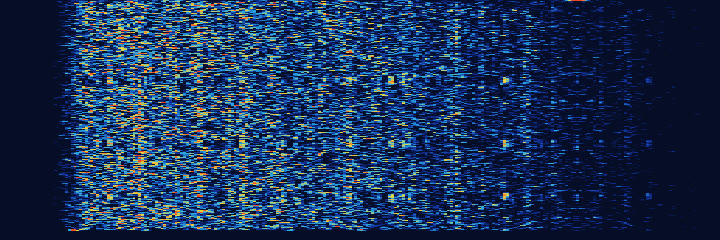
10.7-second example. M17 made with the M17 Project's open-source reference software, then played through a simulated FM radio with added noise and an ordinary speaker's filtering. It is noisy enough that it no longer decodes.
Who uses it?
Amateur radio operators.
Where and when can I hear it?
Ham VHF/UHF.
The science
M17 sends 4,800 symbols per second of four-level frequency shift keying (9,600 bits per second) inside a 9 kHz bandwidth, fitting channels spaced 12.5 kHz apart. Everything travels in fixed 40-millisecond frames of 384 bits, each opening with a short synchronization pattern, and the data is protected by a convolutional code and Golay codes. Voice is compressed with the open Codec 2 speech coder at 3,200 bits per second; the current (version 2) specification also defines a 1,600 bits per second voice-plus-data mode.
Why use it?
Its voice codec, Codec 2, is open source, so anyone can build or modify a radio without licensing a proprietary vocoder, and the ARRL describes M17 as an open-source, patent-free protocol. The specification is published openly on GitHub under free licenses, and it defines optional digital signatures (ECDSA) so a receiver can check who sent a stream, which the project says few modes offer.
Lore
The M17 Project dates to 2019, and the 2021 ARRL Technical Innovation Award honored its creator, Wojciech Kaczmarski, for developing the protocol.
Easily confused with
- DMR digital voice, from the same family
- P25 digital voice, from the same family
- D-STAR digital voice, from the same family