JT65
An older weak-signal mode with one-minute turns, still used for very weak paths such as bouncing signals off the Moon.
What does it sound like?
A slow, burbling series of tones lasting most of a minute, starting at the top of each minute.
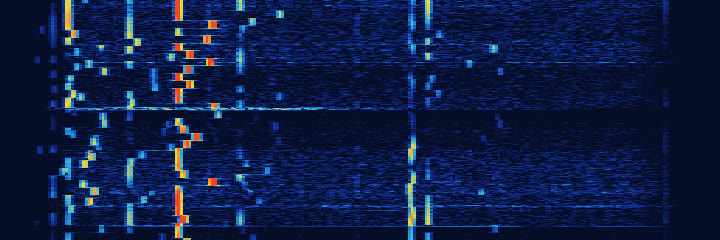
12-second example. JT65 made by Cohera with WSJT-X's simulator, with a little noise added, and read back exactly by WSJT-X's decoder.
Who uses it?
Amateur radio operators.
Where and when can I hear it?
For example 14.076 MHz on shortwave, and VHF/UHF for Moon bounce.
The science
JT65 compresses each message into 72 bits and protects it with a Reed-Solomon (63,12) code, turning it into 63 six-bit symbols. Each symbol picks one of 64 data tones, and these are interleaved with 63 instances of a separate sync tone in a fixed pseudo-random pattern, for 65 tones in all (65-FSK) at about 2.7 symbols per second. A transmission lasts about 47 seconds of a one-minute turn, and the basic submode spans about 178 Hz; wider submodes space the tones two or four times farther apart.
Why use it?
JT65 was designed for Earth-Moon-Earth (moonbounce) contacts, where every decibel counts; it decodes near -25 dB in a 2500 Hz bandwidth, about 4 dB better than FT8. Its one-minute turns make contacts slow, and the WSJT-X guide says it is mostly used today for moonbounce on VHF and higher bands.
Lore
Joe Taylor (K1JT) published the full JT65 description in QEX in September-October 2005. His WSJT program, whose name stands for Weak Signal communications by K1JT, was by then used for the overwhelming majority of VHF meteor-scatter contacts and perhaps half of all moonbounce contacts. For the short replies RO, RRR and 73, JT65 drops its sync pattern entirely and simply alternates between two tones.
What do the decoded parts mean?
- Messages: Short exchanges like FT8's: calls, call signs, grid squares and signal reports.
Easily confused with
- FT8: FT8 turns every 15 seconds, not every minute
- WSPR (propagation beacons): WSPR transmissions last nearly 2 minutes