JT4
A weak-signal mode with one-minute turns, used mainly on microwave bands and for Moon bounce.
What does it sound like?
Slow, steady tones over nearly a minute.
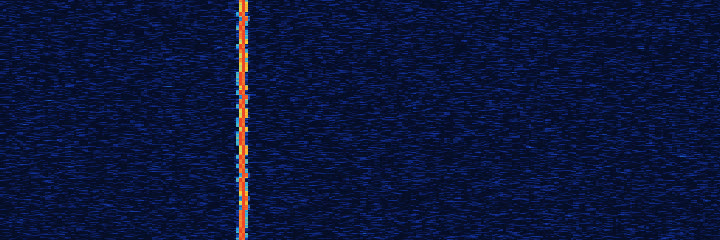
12.0-second example. JT4 (JT4A) made by Cohera with WSJT-X's JT4 simulator, with noise added, and read back by WSJT-X's decoder.
Who uses it?
Amateur radio operators working very long or difficult paths.
Where and when can I hear it?
Microwave ham bands; rarely heard on HF.
The science
JT4 protects a 72-bit message with a powerful convolutional error-correcting code (constraint length 32, rate one-half), producing 206 coded bits. It uses four tones at 4.375 symbols per second, and each tone choice carries one data bit and one known synchronizing bit, so half the transmitted energy goes to helping the receiver lock on. A transmission lasts about 47 seconds of each one-minute turn, and seven submodes (JT4A to JT4G) space the tones anywhere from 4.375 Hz to 315 Hz apart.
Why use it?
Those wide tone-spacing options are JT4's main advantage: when a path smears a signal's frequency (Doppler spread), as difficult moonbounce and microwave paths can, widely spaced tones stay distinguishable where narrowly spaced ones would blur together. It decodes around -23 dB in its narrowest form, and the WSJT-X guide says it has proven highly effective for moonbounce on bands up to 24 GHz.