Wireless sensor bursts (433/315 MHz)
Short on-off data bursts from everyday wireless gadgets.
What does it sound like?
A quick, crisp rattle or 'brrrt', repeating at regular intervals.
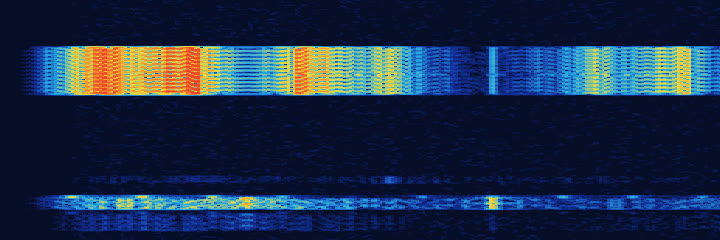
5.0-second example. Recorded off the air on the developer's own receiver: a wireless temperature sensor's burst near 433.92 MHz.
Who uses it?
Home weather stations, wireless thermometers, doorbells, car key fobs, tire-pressure sensors and remote controls.
Where and when can I hear it?
433.92 MHz and 315 MHz, repeating every few seconds to minutes.
The science
Many of these gadgets use on-off keying, the simplest digital radio method: the transmitter switches its carrier on and off, and the pattern and lengths of the pulses carry an ID code and a reading. In the U.S. such devices commonly fall under FCC rule 15.231. Its main provisions require a hand-pressed transmitter to shut off within 5 seconds of release and forbid regular timed transmissions, except that security and safety devices may send system check-ins totaling no more than 2 seconds per hour. An alternative provision allows regular data at lower power, but only if each transmission lasts no more than one second and is followed by a silence at least 30 times as long, and never less than 10 seconds. That is why you hear short, crisp bursts rather than a steady signal.
Why use it?
On-off keying needs very little circuitry: the transmitter only has to switch its carrier, and the receiver only has to decide whether energy is present in each time slot, which suits cheap coin-cell sensors and key fobs. The 433.92 MHz center frequency comes from the international Radio Regulations, which designate 433.05-434.79 MHz in Europe, Africa and the Middle East (Region 1) for industrial, scientific and medical uses, and low-power devices share that space.
Lore
On-off keying is the same principle as Morse code sent by radio, where a hand key switches the carrier; a sensor chip simply does the switching far faster.
Easily confused with
- Wireless meter and sensor bursts (868/915 MHz): FSK bursts shift tone instead of switching on and off