Hellschreiber (Feld Hell)
An old method that 'paints' text as a picture, dot by dot, so your eye does the decoding.
What does it sound like?
A rough, rasping buzz with a steady rhythm.
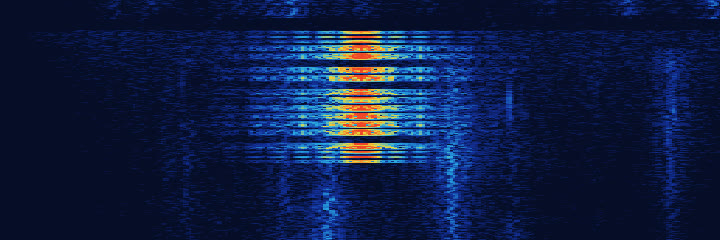
12-second example. A clean example made with the free fldigi program (Feld Hell); signals on the air usually sound noisier.
Make your own: type a message and hear it as Hellschreiber (Feld Hell) in the Signal Maker.
Who uses it?
Amateur radio enthusiasts (the Feld Hell Club holds regular activity sessions).
Where and when can I hear it?
Various ham frequencies.
The science
Hellschreiber scans each letter like a dot-matrix printer, sending it as columns of dots from bottom to top, left to right, typically 14 dot positions per column and up to seven columns per character. In Feld Hell the carrier is simply switched on for a black dot and off for white, at 122.5 dots per second, giving about 2.5 characters per second in roughly 350 Hz. The receiver does no decoding at all: it paints the dots on a scrolling strip, and the human eye reads the letters.
Why use it?
Because the eye does the decoding, noise shows up as smudges and specks rather than as wrong characters, and faint text can still be read through heavy interference. It uses no synchronization and is easy to tune, although fldigi notes it is not especially sensitive.
Lore
Rudolf Hell patented the system in 1929, and the portable Feld-Hell machine (Feld means field) entered service with the German armed forces in 1935 and was used until the end of World War II. Its printer used a spindle with a two-turn thread that printed every line twice, one above the other, so the text could be read without synchronizing sender and printer, even when their motors ran at slightly different speeds.
Easily confused with
- FSK Hell: FSK Hell uses two tones
- Morse code (CW): Morse is a single keyed tone in dots and dashes