Ham digital image (HamDRM / digital SSTV)
Pictures and files sent by hams using a DRM-style digital signal instead of analog SSTV.
What does it sound like?
A steady, narrow block of hiss, a few seconds to minutes long.
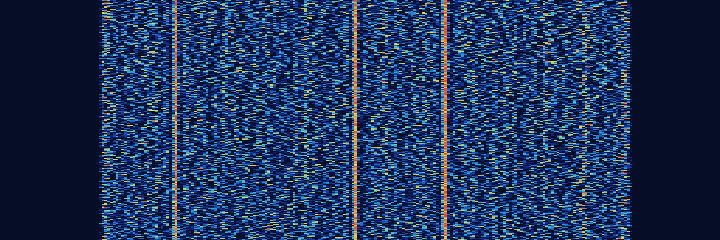
10.0-second example. A HamDRM demonstration made by its uploader with the free QSSTV program and never sent over the air (Internet Archive, CC0); on the air it sounds noisier.
Who uses it?
Amateur radio operators.
Where and when can I hear it?
Ham bands, often near the SSTV frequencies (for example around 14.230 MHz).
The science
HamDRM shrinks the broadcast DRM system to fit an ordinary SSB voice channel of 2.3 or 2.5 kHz. The signal is made of 29 to 57 closely spaced subcarriers (COFDM), each carrying 4-, 16- or 64-state QAM; 64-QAM is fastest but needs a signal-to-noise ratio of about 18 dB, while 4-QAM gets through at about 5 to 6 dB. Files are sent in segments with Reed-Solomon error correction, so a picture can build up during reception.
Why use it?
Unlike analog SSTV, the picture or file arrives as digital data protected by error correction, and the receiving station can send a bad segment report so only damaged pieces are resent. Its modes trade speed for resistance to fading, and the same system can carry images, other data files and even voice.
Lore
HamDRM was created by Francesco Lanza, adapting the open DRM broadcast standard for amateur SSB channels.