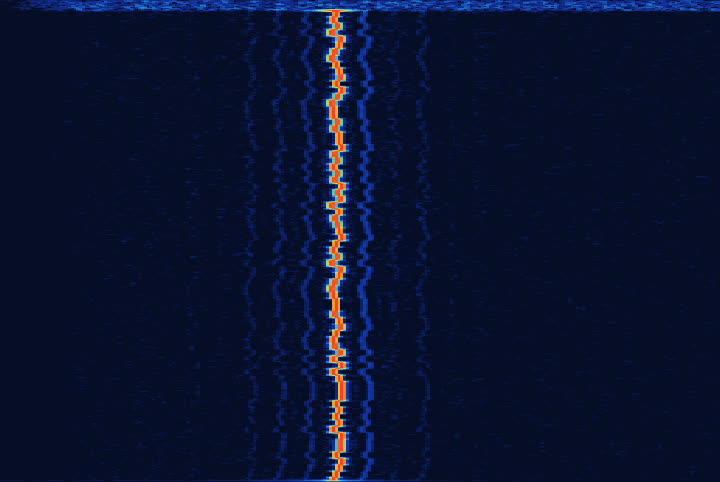
0 Hz1,0002,0003,000 Hz
Tap a step to hear that moment. The box shows where it is on the waterfall.
A weak-signal digital mode where stations exchange short, standard messages in 15-second turns. It can be copied even when the signal is too weak to hear.
FT8 sounds like a cluster of soft, quiet musical warbles side by side that all start together, run for about 13 seconds, and stop, repeating every 15 seconds.
Many soft, quiet musical warbles side by side, starting and stopping together every 15 seconds.
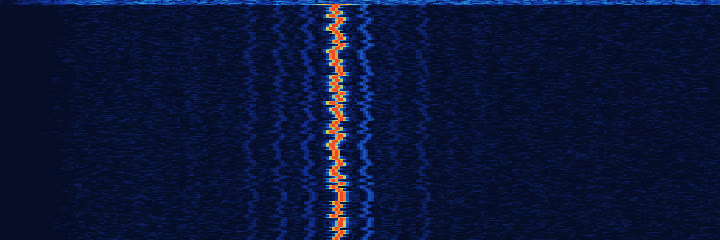
12-second example. Recorded off the air on the developer's own receiver.
This FT8 clip, recorded off the air on 10 meters, holds one strong transmission plus a few faint copies of it.
Tap a step to hear that moment. The box shows where it is on the waterfall.
Make your own: type a message and hear it as FT8 in the Signal Maker.
Amateur radio operators; it is the busiest digital mode on the ham bands.
For example 7.074, 14.074 and 28.074 MHz. Transmissions start just after :00, :15, :30 and :45 seconds past each minute.
Hear it live
These are free public receivers run by other people; we only link to them. You'll hear the signal only if it's on the air right now and conditions carry it to that receiver, so if it's quiet, try another time. Links last reviewed 2026-09-28.
FT8 packs a short, structured message (call signs, a grid locator, a signal report or an acknowledgment) into exactly 77 bits, adds a 14-bit checksum, and protects the result with a low-density parity-check (LDPC) code, an error-correcting code that lets the receiver repair bits lost to noise; the full codeword is 174 bits. Those bits are sent as 79 symbols using eight tones (8-GFSK, frequency-shift keying with smoothed transitions) at 6.25 symbols per second, so one signal occupies only 50 Hz and lasts about 12.6 seconds of each 15-second turn. Three fixed seven-tone patterns called Costas arrays sit at the start, middle and end so the receiver can lock onto the exact time and pitch, and the decoder removes each signal it decodes from the audio and searches again, which can reveal weaker signals hidden underneath.
FT8 trades a little sensitivity for speed: its designers accepted about 4 dB less sensitivity than the older JT65 in exchange for 15-second turns instead of one-minute turns. It still decodes at roughly 21 dB below the noise in a 2500 Hz bandwidth, so stations with a few watts and simple antennas can make contacts across the world, and many 50 Hz-wide signals fit side by side in one ordinary voice channel.
FT8 was introduced in July 2017 with version 1.8 of the free WSJT-X software and within a short time accounted for a large share of all ham activity on the HF bands. Its lead developer, Joe Taylor (K1JT), shared the 1993 Nobel Prize in Physics with Russell Hulse for discovering a new type of pulsar.
The timing is the giveaway. Every signal in an FT8 segment begins within a second or so of :00, :15, :30 or :45 past the minute, lasts about 12.6 seconds, and then the whole band goes quiet while stations decode and decide what to send next. On a waterfall display, you see neat rows of short stripes, all lined up in time like bricks.
Each individual signal is only about 50 Hz wide. It steps among eight tones spaced 6.25 Hz apart, changing tone about six times a second, which gives it a gentle, burbling, almost melodic sound. Many signals are too weak to hear at all: FT8 was designed to be copied well below the noise.
Easily confused with:
FT8 has standard spots on nearly every ham band. Common dial frequencies (upper sideband) include 3.573, 7.074, 10.136, 14.074, 18.100, 21.074, 24.915, 28.074 and 50.313 MHz. The signals sit in the first 3 kHz above the dial frequency.
There is almost always activity somewhere: 20 meters (14.074 MHz) during the day, 40 and 80 meters at night, and 10 and 6 meters when those bands open. Because thousands of stations report what they receive to public maps such as PSK Reporter, FT8 has also become a quick way to see which bands are open right now.
FT8, created by Joe Taylor (K1JT, a Nobel Prize-winning astrophysicist) and Steve Franke (K9AN), was introduced in July 2017 in version 1.8 of the free program WSJT-X. It built on earlier weak-signal modes such as JT65 and JT9, but its 15-second turns made contacts four times faster than the one-minute modes. It spread with unusual speed and within a couple of years accounted for a large share of all activity on the HF ham bands.
Each FT8 transmission carries exactly 77 bits of information, protected by strong error correction and a checksum, so a damaged message is almost always rejected rather than shown wrong.
Yes. FT8 is an open amateur radio mode with a published specification; anyone may receive and decode it. Only transmitting requires an amateur license.
FT8 can be decoded at about 20 dB below the noise in a normal 2.5 kHz receiver bandwidth. Many of the stations your computer decodes are far too weak for your ears to pick out.
The most common cause is the computer clock. Transmissions and decoding are locked to 15-second periods, so the clock needs to be accurate to within about a second. Setting it from an internet time source usually fixes it.
The free, open-source program WSJT-X, which introduced the mode, is the reference decoder. It needs audio from a receiver tuned to one of the standard frequencies in upper sideband.