FT4
A faster cousin of FT8 with 7.5-second turns, built for contests.
FT4 sounds like a busier, slightly harsher FT8: soft warbling tones about 90 Hz wide that start and stop together every 7.5 seconds, giving a quick back-and-forth rhythm.
What does it sound like?
Like FT8 but slightly wider and rougher, with turns switching every 7.5 seconds.
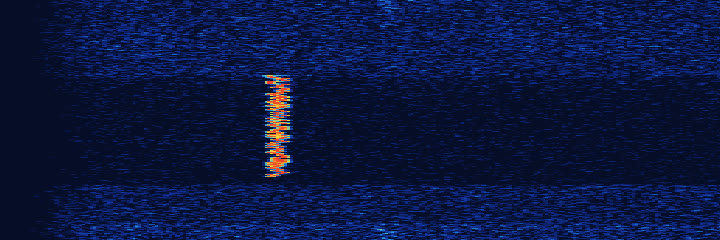
12-second example. Recorded off the air on the developer's own receiver.
Who uses it?
Amateur radio operators, especially during contests.
Where and when can I hear it?
For example 7.0475 and 14.080 MHz.
What do the decoded parts mean?
- Messages: The same kinds of short exchanges as FT8: calls, call signs, grid squares and signal reports.
Easily confused with
- FT8: FT8 turns every 15 s and is narrower
How to recognize it
FT4 uses four tones instead of FT8's eight, spaced about 21 Hz apart and changing about 21 times a second, over three times as fast as FT8. That makes each signal roughly 90 Hz wide and gives it a quicker, rougher warble. Transmissions last about 5 seconds within 7.5-second turns, so the band flips between the two sides of each contact twice as often as FT8.
On a waterfall, FT4 looks like short, fat blocks lined up in neat rows, twice as many per minute as FT8's stripes.
Easily confused with:
- FT8: narrower, gentler, with 15-second turns.
- JS8Call: FT8-like sound on its own frequencies, with longer messages.
- MFSK and Olivia: continuous multi-tone signals without a fixed turn clock.
Where and when to hear it
FT4 has its own spots, separate from FT8. Common dial frequencies (upper sideband) include 3.575, 7.0475, 10.140, 14.080, 18.104, 21.140, 24.919 and 28.180 MHz. It is quietest during ordinary weekdays and busiest during contests, when its speed counts; some contests have dedicated FT4 categories, and the ARRL RTTY Roundup allows it.
During a big contest weekend, the FT4 segment can fill from edge to edge with blocks switching every 7.5 seconds, and the rhythm is noticeably quicker than an FT8 segment next door. Outside contests you may hear only a handful of stations. As with FT8, stations report what they receive to public maps such as PSK Reporter, which is a fast way to check whether anyone is active.
A little history
FT4 was introduced in 2019 with WSJT-X version 2.1, by the same team that created FT8 (Joe Taylor, K1JT, Steve Franke, K9AN, and collaborators). The goal was a mode fast enough for contests, where the number of contacts per hour matters more than squeezing the last decibel of sensitivity out of a weak signal.
The trade-off is measured and published: FT4 can be decoded down to about 17.5 dB below the noise in a 2.5 kHz bandwidth, about 3 dB less sensitive than FT8, in exchange for contacts that go twice as fast. It carries the same 77-bit messages as FT8, with the same error correction and checksum.
Common questions
Is it legal to listen to FT4?
Yes. It is an open amateur mode with a published specification, and anyone may receive it.
What is the difference between FT4 and FT8?
FT4 is about twice as fast (7.5-second turns instead of 15), uses four tones instead of eight, and is about 90 Hz wide instead of 50. FT8 is about 3 dB more sensitive, so it works better on the weakest signals.
Why is FT4 mostly heard during contests?
It was designed for contesting, where speed matters. Outside contests, most operators prefer FT8's extra sensitivity.
How do I decode FT4?
The free program WSJT-X decodes FT4. Choose FT4 mode, tune to an FT4 dial frequency in upper sideband and make sure the computer clock is accurate.