FST4 / FST4W
Weak-signal modes related to FT8 and WSPR, with longer turns for very low frequencies and very weak paths.
What does it sound like?
Slow, faint tones over long turns, similar to WSPR.
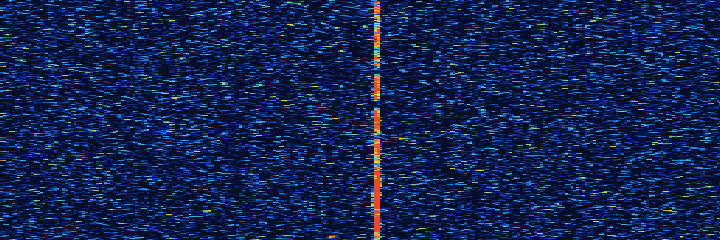
12-second example. FST4W made by Cohera with WSJT-X's simulator, set weaker than the background noise, as it usually is on the air; WSJT-X's decoder read the message back exactly.
Who uses it?
Amateur radio operators, especially on the low-frequency bands (136 kHz and 475 kHz).
Where and when can I hear it?
Low and medium frequency ham bands, plus some HF.
The science
FST4 (for two-way contacts) and FST4W (for WSPR-style beacons) send 160 symbols with four smoothed tones (4-GFSK): 120 data symbols carrying two bits each plus five groups of eight known sync symbols. FST4 carries a 77-bit message and FST4W a 50-bit message, each with a 24-bit checksum, protected by LDPC error-correcting codes. The same packet can be stretched over turns from 15 seconds up to 30 minutes; at the 30-minute setting the keying rate falls to 0.089 symbols per second and the signal is only about 0.36 Hz wide.
Why use it?
Slowing down concentrates energy into a very narrow signal, so as long as both stations' frequencies are stable enough, sensitivity improves with every longer turn: from about -28 dB for one-minute FST4 to about -43 dB for the 30-minute setting, and down to about -45 dB for FST4W. That matters on the 2200 meter and 630 meter bands (around 136 kHz and 475 kHz), where transmit power and antennas are severely limited; the WSJT-X guide says FST4W has significant advantages over WSPR there.
Lore
FST4 and FST4W arrived together in the WSJT-X 2.3.0 release candidates starting September 28, 2020, and the finished version 2.3.0 followed on February 2, 2021. The slowest settings are so narrow that both stations' frequencies must stay stable to better than 0.089 Hz for half an hour.