0 Hz1,0002,0003,000 Hz
Tap a step to hear that moment. The box shows where it is on the waterfall.
The pairs of tones a telephone keypad makes. On radio they send numbers and commands.
Short beeps that sound exactly like pressing phone buttons.
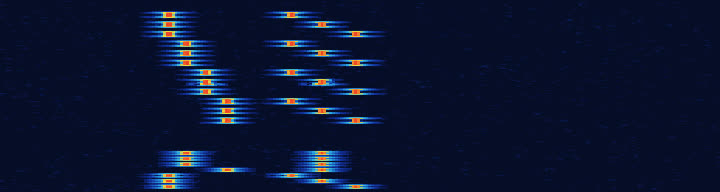
4.8-second example. Telephone keypad tones made by Cohera: 1 through 9, *, 0 and #, then a quickly dialed number.
This computer-made clip presses the telephone keys 1 through 9, star, 0 and pound, then quickly dials a made-up number.
Tap a step to hear that moment. The box shows where it is on the waterfall.
Make your own: type a message and hear it as Touch-tone (DTMF) in the Signal Maker.
Repeater owners controlling equipment, radio users dialing phone patches or identifying themselves, some business systems.
Mostly on VHF/UHF FM channels, in short bursts.
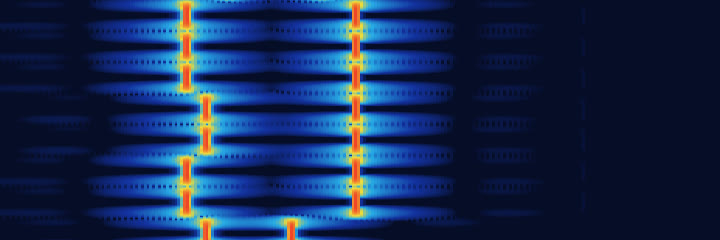
Each key sends two tones at once, one from a low group (697, 770, 852 or 941 Hz) and one from a high group (1209, 1336, 1477 or 1633 Hz). The low tone marks the key's row and the high tone its column, so eight tones make 16 combinations: the digits, star, pound, and four extra keys labeled A to D. A decoder recognizes a key only when it hears exactly one tone from each group.
Requiring a specific pair of tones makes it hard for ordinary speech or background sound to fake a key press, so tone signaling works reliably over an ordinary voice channel. Because every radio and phone can pass these tones, DTMF gives a cheap, universal way to send numbers and commands without any extra data equipment.
The Bell System began commercial Touch-Tone service in the fall of 1963 in Carnegie and Greensburg, Pennsylvania, near Pittsburgh, as a premium service costing an extra $1.50 a month. A team led by Leo Schenker developed the tone-pair approach.