Packet radio (AX.25)
Short bursts of digital data sent using two audio tones: 1200 baud on VHF and UHF (the same system used for APRS), 300 baud on HF.
What does it sound like?
A short, harsh 'brrrap' buzz, like an old dial-up modem.
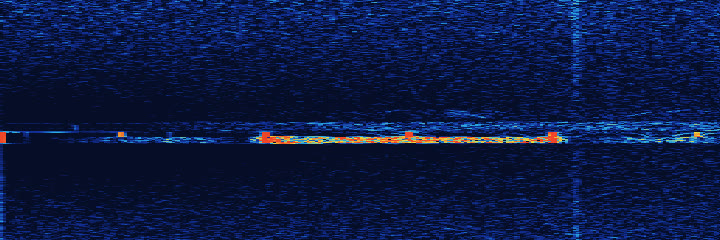
12-second example. Recorded off the air on the developer's own receiver: an APRS packet on 144.390 MHz.
Who uses it?
Amateur radio operators (bulletin boards, email gateways, networks) and some satellites.
Where and when can I hear it?
VHF/UHF ham frequencies, and some HF channels at 300 baud.
The science
AX.25 wraps data in frames that start and end with the flag pattern 01111110 (hex 7E); bit stuffing inserts a zero after any five ones in the data so the flag can never appear by accident. Each frame carries the sending and receiving stations' callsigns with a 4-bit station identifier (SSID), optional digipeater addresses, and a 16-bit frame check sequence that lets the receiver discard any frame damaged in transit. On VHF and UHF the bits are usually sent as Bell 202 audio tones, 1200 Hz and 2200 Hz at 1200 bits per second; on HF the usual mode is 300 baud with two tones 200 Hz apart.
Why use it?
A damaged frame fails its check and is thrown away, and on connected links it is sent again, so the data that gets through is correct. The 1200 bit-per-second tones pass through any radio designed for voice. Stations can link directly, relay through digipeaters, or broadcast unconnected frames to everyone listening, which made AX.25 a flexible base for packet networks and APRS.
Lore
In July 1984 the International Amateur Radio Union named the ARRL the international clearinghouse for packet radio information, and version 2.0 of AX.25 was published that year. The protocol follows the HDLC data-link standards.
What do the decoded parts mean?
- From / to: The call signs of the sending and receiving stations.
- Path: The relay stations the packet passed through.
- Data: The message or data the packet carries.
Easily confused with
- APRS (position and messaging): APRS is one use of AX.25 packet