APRS (position and messaging)
A ham radio system for sharing positions, weather readings and short messages in packet bursts.
APRS sounds like a short, raspy data burst, about a second or less, like an old dial-up modem clearing its throat, repeating every few seconds on a busy channel.
What does it sound like?
A short 'brrrap' data burst every so often, like an old modem.
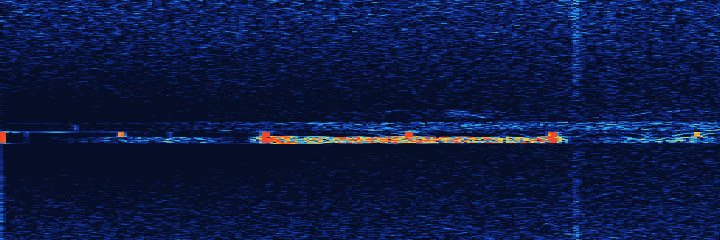
12-second example. Recorded off the air on the developer's own receiver.
Who uses it?
Amateur radio operators, including cars, hikers, weather stations, balloons and the International Space Station.
Where and when can I hear it?
144.390 MHz in North America and 144.800 MHz in Europe; also 145.825 MHz via the space station.
What do the decoded parts mean?
- Call sign: Who sent it, often with a number (SSID) like -9 for a car.
- Position: Latitude and longitude, sometimes with speed and direction.
- Symbol: What kind of station it is: car, house, weather station, balloon and so on.
- Path: Relay stations (digipeaters) that repeated it, such as WIDE1-1.
- Comment or weather: Free text, or readings like temperature, wind and rain for weather stations.
Easily confused with
- Packet radio (AX.25): APRS is AX.25 packet carrying positions and messages
- Touch-tone (DTMF): touch-tones are two pure tones, one key at a time
How to recognize it
Each APRS packet is sent using two audio tones, 1200 Hz and 2200 Hz, switched at 1200 bits per second (the old Bell 202 modem standard). To the ear that becomes a brief, gritty "brrrap." A packet starts with a short steady section that lets receivers lock on, then the data itself.
The channel is shared, so bursts come from many stations: a car reporting its position, a weather station sending readings, a relay station (digipeater) repeating another station's packet a moment later. In a busy area you may hear one burst after another; in quiet country, minutes can pass between them.
Easily confused with:
- Pager signals (POCSAG): harsher and buzzier, often longer, and heard on paging channels rather than 144.390 MHz.
- Other packet radio: the same sound, but on other frequencies and often at other speeds.
- DTMF tones: individual beeps, not a continuous burst of data.
Where and when to hear it
In North America, APRS uses 144.390 MHz; in Europe, 144.800 MHz; other regions have their own channels. Any scanner or FM receiver that covers the 2-meter ham band can hear it. Activity is highest near highways and cities and during public service events, when hams track race vehicles or support teams.
When the International Space Station's packet radio is switched on, it relays APRS on 145.825 MHz, and during a pass you can hear packets from stations hundreds of miles away. High-altitude balloons flown by schools and hobbyists often send APRS too. Packets heard by internet-connected receivers (igates) are collected into public maps such as aprs.fi.
A little history
APRS was created by Bob Bruninga, WB4APR, a senior research engineer at the U.S. Naval Academy, in the early 1990s. He built it on AX.25, the amateur packet radio protocol of the 1980s, but turned packet radio from point-to-point connections into a shared, one-to-many broadcast: every station says where it is and what it sees, and everyone listening builds the same picture. Bruninga continued developing it until his death in February 2022.
The system has since grown to carry weather data, short messages, bulletins, telemetry from balloons and satellites, and object reports such as the location of a storm or an event checkpoint.
Common questions
Is it legal to listen to APRS?
Yes. APRS is an open amateur radio system; its packets are sent in the clear specifically so that anyone can receive them, and much of it is already published on public maps.
Why does APRS sound like a modem?
It uses the same two-tone signaling as early telephone modems (Bell 202), at 1200 bits per second. Your ear hears the two tones switching very quickly as a burst of rough noise.
Can I see APRS positions without a radio?
Yes. Public websites such as aprs.fi collect packets heard by internet-connected receivers around the world and plot them on a map.
How do I decode APRS myself?
Free software such as Dire Wolf can decode APRS from a receiver's audio or a low-cost software-defined radio, and pass the results to mapping programs.